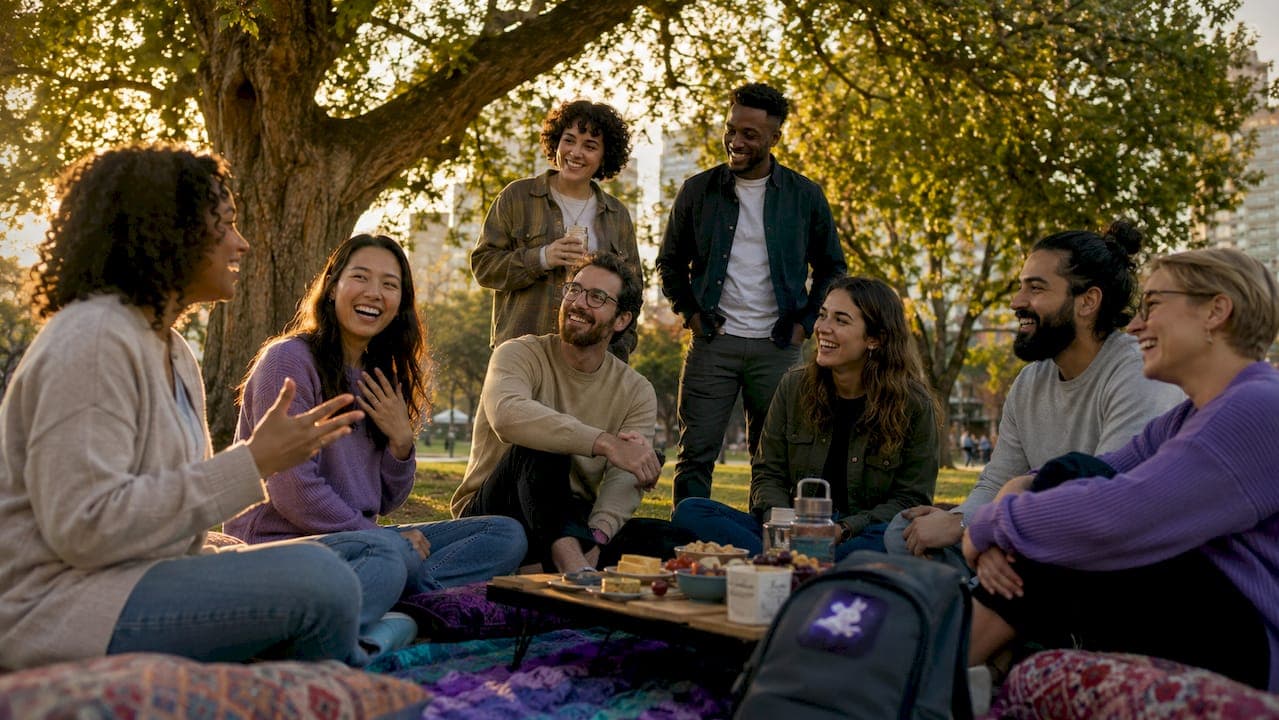
Community storytelling formats are structured methods that bring people together to share, listen to, and co-create narratives reflecting collective experiences. The types of community storytelling formats range from intimate story circles to visual methods like Photovoice and systems-mapping tools like Ripple Effects Mapping (REM). The University of Kentucky's land-grant engagement project uses all three, training groups of 38 participants in single sessions to connect researchers and communities through shared narrative. Each format serves a different purpose, and choosing the right one shapes how deeply your audience engages.
1. What are the main types of community storytelling formats?
Community storytelling formats fall into three broad categories: structured group methods, visual participatory methods, and interactive collaborative games. Structured methods like story circles and Narrative 4 prioritize trust and shared meaning. Visual methods like Photovoice and graffiti elicitation combine imagery with narrative to surface emotional depth. Interactive formats like pass-the-story circles work across ages and require no preparation at all.
Each category suits different goals. If you want personal connection, story circles work best. If you want to document community knowledge, visual methods deliver more. If you want to build group energy and creativity, interactive games are the right call.
2. Story circles: the foundation of group storytelling
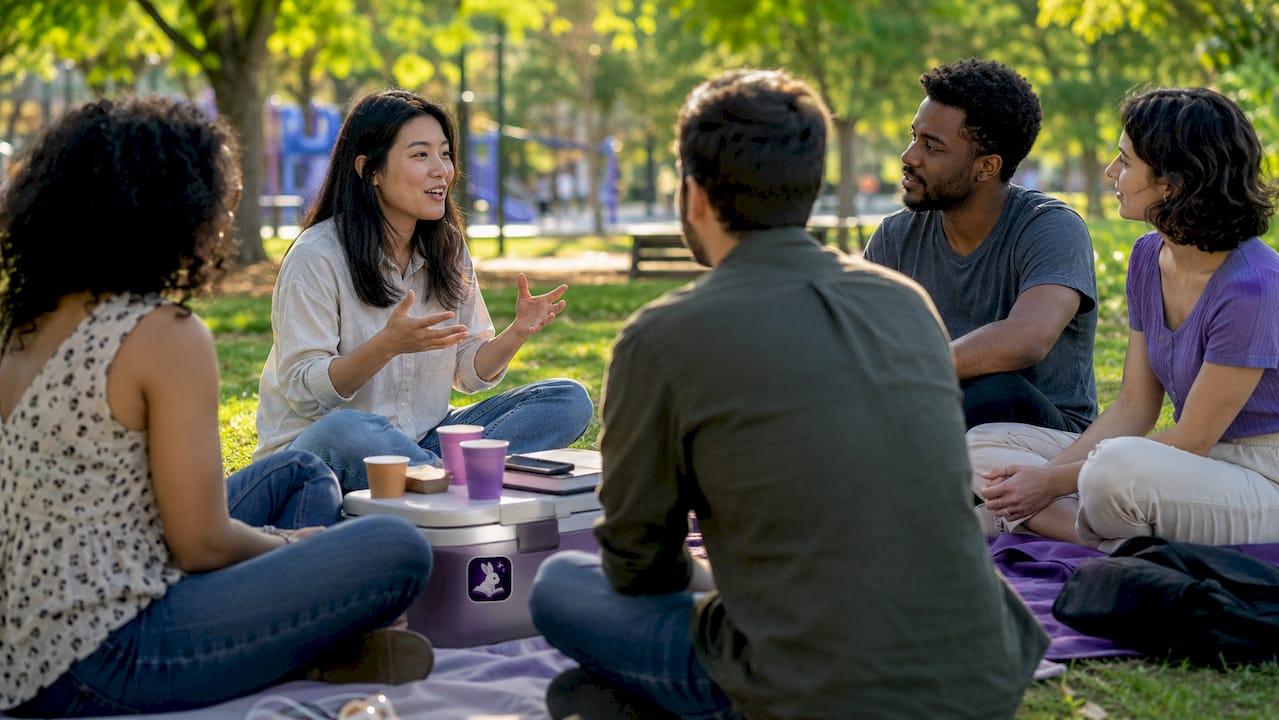
Story circles are deliberate, facilitated gatherings where participants share personal narratives around a central theme. They are not casual conversations; the facilitator's goal is for the group to hear a story larger than any single participant's experience. That collective narrative is what makes story circles so powerful for civic dialogue, public health education, and community organizing.
The structure depends on agreements, not just prompts. Facilitators establish ground rules before anyone speaks: tell from lived experience, listen without interruption, and hold space for discomfort. These agreements build the trust that surfaces shared truths.
Story circles work well when you:
- Need to build trust across divided groups
- Want to surface lived experience in public health or education settings
- Are preparing a community for collective action or civic dialogue
- Need qualitative data that reflects emotional and social realities
Pro Tip: Start every story circle with a low-stakes personal prompt, like "describe a meal that reminds you of home," before moving to the central theme. This warms participants up and establishes the norm of personal, honest sharing.
Narrative Arts, a leading practitioner organization, uses story circles in community media projects to create feedback loops between storytellers and audiences. The format scales from small classroom groups to large civic events without losing its core intimacy.
3. Visual participatory methods: Photovoice and graffiti elicitation
Photovoice is a community storytelling technique where participants photograph their own environments and then use those images as the basis for group discussion and narrative. Photovoice provides access into emotional and lived experience layers that traditional research methods miss entirely. A resident photographing a cracked sidewalk tells a different story than a city planner mapping infrastructure.
Graffiti elicitation interviews take a related approach. A facilitator presents participants with an image, a wall of words, or a visual prompt and invites them to respond with their own markings, words, or drawings. This method has roots in decolonizing research practices and works especially well with communities where verbal or written expression carries cultural barriers.
| Method | Core tool | Best for | Output |
|---|---|---|---|
| Photovoice | Personal photography | Documenting lived experience | Photo essays, group narratives |
| Graffiti elicitation | Visual prompts and markings | Cross-cultural and youth groups | Visual maps, annotated images |
| Digital storytelling | Video and audio | Intergenerational dialogue | Short films, audio stories |
Visual methods are especially effective when you need to:
- Surface knowledge that participants struggle to verbalize
- Engage youth, Indigenous communities, or multilingual groups
- Create artifacts that can be shared publicly or with policymakers
- Build emotional connection to a place or issue
Community Digital Storytelling extends these visual methods into the digital space, centering Indigenous knowledge and fostering intergenerational dialogue. It has become a key tool for local adaptation to issues like climate change, where community-held knowledge is often more accurate than external data.
4. Ripple Effects Mapping: visualizing collective impact
Ripple Effects Mapping (REM) is a participatory evaluation method that uses storytelling to map the broader impacts of a community program or initiative. Participants narrate what changed in their lives and communities, and a facilitator maps those changes visually as ripples spreading outward from a central event. REM visually maps community impacts as interconnected ripple effects, making invisible change visible.
REM sits at the intersection of storytelling and systems thinking. It does not just collect individual stories. It shows how those stories connect, overlap, and amplify each other across a community. This makes it particularly useful for organizations that need to demonstrate impact to funders or policymakers.
REM works best when you:
- Need to evaluate a program's community-wide effects
- Want participants to see their own contributions to collective change
- Are working on systems-change initiatives with long time horizons
- Need a visual output that communicates impact without heavy data analysis
Pro Tip: Record the mapping session on video. The conversation that happens as participants place their ripples on the map often contains the richest insights, and those moments are easy to miss in written notes alone.
REM also has a motivating effect on participants. Seeing their individual experiences mapped as part of a larger pattern builds a sense of collective agency that is hard to achieve through surveys or focus groups alone.
5. Pass-the-story circles and collaborative storytelling games
Pass-the-story circles are zero-prep collaborative storytelling games that engage diverse groups, including children and mixed-age audiences, in building a shared narrative together. Each participant adds one sentence or one word before passing the story to the next person. The result is always surprising, often funny, and consistently effective at building group cohesion.
The key rule is the "yes-and" principle from improv. Each participant accepts what the previous person said and builds on it, rather than contradicting or redirecting. This keeps the narrative moving and signals to every participant that their contribution matters.
Popular variations include:
- One-word story: Each person adds only one word, forcing close listening and creative flexibility.
- Draw-along story: Participants illustrate each story beat as it is spoken, creating a visual record.
- Mystery bag prompts: A bag of random objects is passed around, and each participant must incorporate the object they pull out into the next story beat.
- Sentence-at-a-time: Each person adds a full sentence, giving more narrative control and suiting older groups.
Benefits for participants:
- Builds vocabulary and verbal confidence, especially in younger groups
- Develops active listening skills through the "yes-and" structure
- Creates a shared artifact (the story) that belongs to the whole group
- Requires no materials, budget, or prior experience
Pass-the-story circles are a strong entry point for organizers who are new to participatory storytelling. They lower the barrier to participation and create immediate group energy that carries into more structured formats later in a session.
6. Choosing the right format for your community goals
Combining storytelling methods like Photovoice, REM, and narrative workshops helps meet different community needs, from personal connection to systems-level change. No single format does everything. The best community organizers treat these methods as a toolkit, not a menu.
Match your format to your goal. Story circles build trust and surface personal narratives. Photovoice documents place-based knowledge and creates public artifacts. REM evaluates collective impact and motivates continued participation. Pass-the-story games build group energy and lower barriers for new participants.
Consider your participants' readiness. A community that has never engaged in structured storytelling needs a warm-up format like a pass-the-story circle before moving into the emotional depth of a story circle. A community already engaged in advocacy work may be ready for REM or Photovoice from the start.
Also consider your output. If you need a report, REM produces visual maps that translate well into written summaries. If you need public engagement, Photovoice produces images and narratives that work in exhibitions, social media, and policy presentations. If you need internal cohesion, story circles produce shared understanding that does not always need an external output at all.
A storytelling intervention in Northern Ghana showed what these formats can achieve at scale. Emotional relief increased from 20% to 70%, perceived social support rose from 30% to 80%, and trust climbed from 25% to 65% through a structured community storytelling program. Those numbers show that format choice and facilitation quality directly shape outcomes.
Key takeaways
The most effective community storytelling formats combine clear structure, skilled facilitation, and a format matched to the specific goal, whether that goal is personal connection, collective evaluation, or public engagement.
| Point | Details |
|---|---|
| Match format to goal | Story circles build trust; Photovoice documents knowledge; REM maps impact; games build energy. |
| Facilitation drives outcomes | Ground rules and agreements matter more than prompts in structured formats like story circles. |
| "Yes-and" keeps stories moving | The improv rule prevents contradiction and signals that every contribution has value. |
| Visual methods surface hidden knowledge | Photovoice and graffiti elicitation reach emotional layers that verbal methods often miss. |
| Combine methods for deeper impact | Blending Photovoice, REM, and narrative workshops meets both personal and systems-level needs. |
Why participatory storytelling is harder than it looks
The formats in this article are well-documented and genuinely effective. But I want to be honest about something most guides skip: the gap between knowing a format and facilitating it well is significant.
Story circles, in particular, require a facilitator who can hold silence, redirect without dismissing, and recognize when a participant is sharing something that needs care rather than just a turn to the next person. I have seen well-intentioned organizers run story circles that felt extractive rather than empowering, because the agreements were rushed and the facilitator was more focused on the output than the room.
True community storytelling shifts power to participants by co-creating stories and ensuring agency. That principle sounds simple. Practicing it means slowing down, building trust before you collect anything, and being willing to let the session go somewhere you did not plan.
The trend I find most exciting right now is intergenerational digital storytelling. Community Digital Storytelling centers Indigenous knowledge and creates locally led narratives that external researchers cannot replicate. When elders and young people co-create a story using both oral tradition and digital tools, the result carries a kind of authority that no outside-produced content can match.
My advice to organizers: start with the format that feels most accessible to your community, not the one that produces the most impressive output. Build the trust first. The richer formats will follow naturally.
— Noctilucente
Curio is a great place to go deeper on storytelling
Reading about storytelling formats is one thing. Sitting with a well-told story, long enough to feel how it works, is another experience entirely.
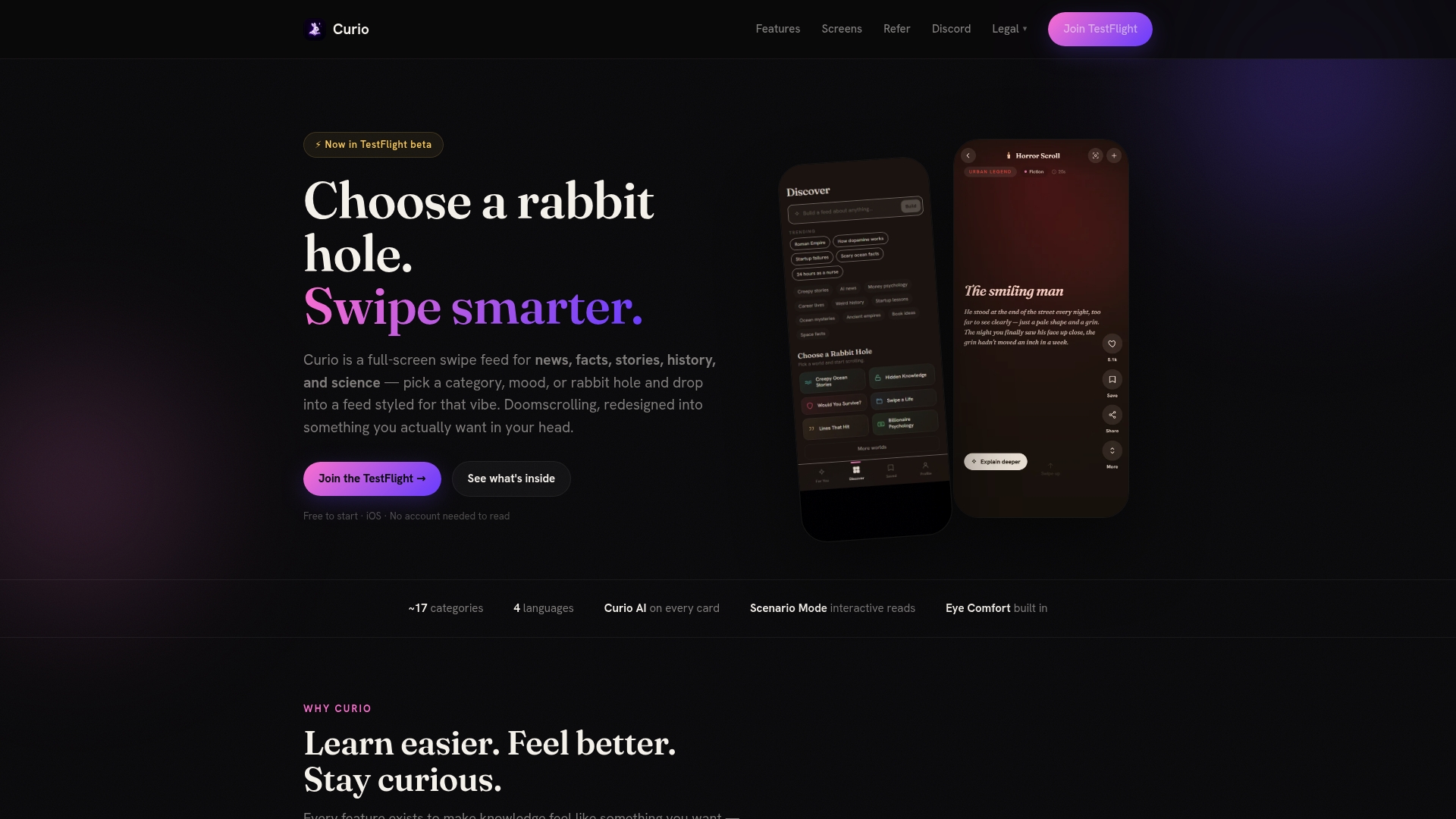
Curio is a focused reading app built for readers who want to go deep without distraction. Its full-screen reading experience removes the noise of a typical feed so you can actually absorb what you are reading. Whether you are researching community storytelling techniques, exploring narrative structures in communities, or looking for examples of community tales from around the world, Curio surfaces quality content and lets you quiz yourself, summarize, or go further down the rabbit hole. Visit Curio to read stories and ideas that actually stick.
FAQ
What is a community storytelling format?
A community storytelling format is a structured method for groups to share, listen to, and co-create narratives that reflect collective experiences. Examples include story circles, Photovoice, Ripple Effects Mapping, and pass-the-story games.
What is the "yes-and" rule in collaborative storytelling?
The "yes-and" rule, borrowed from improv, requires each participant to accept the previous contribution and build on it rather than contradict it. It keeps the narrative moving and signals that every voice in the group has value.
How does Photovoice work as a storytelling method?
Photovoice participants photograph their own environments and use those images as the basis for group discussion and narrative. The method surfaces emotional and lived-experience layers that traditional research methods typically miss.
When should you use Ripple Effects Mapping?
Use Ripple Effects Mapping when you need to evaluate a program's community-wide impact and want participants to see how their individual experiences connect to collective change. It works especially well for systems-change initiatives and impact reporting.
How do you choose between different community storytelling formats?
Match the format to your goal: story circles for trust-building, Photovoice for documenting place-based knowledge, REM for evaluating collective impact, and pass-the-story games for warming up new groups or engaging mixed-age audiences.