
Spark student curiosity reading activities are intentional, interactive exercises that transform reading from a passive task into an active, inquiry-driven experience. Educators who practice inquiry-based literacy instruction, a method recognized in current pedagogical standards, know that curiosity is not a personality trait students either have or lack. It is a teachable habit of mind. Organizations like Edutopia and Van Andel Institute have long championed this view, showing that when students ask their own questions about a text, comprehension deepens and critical thinking follows naturally. The strategies in this article give you concrete tools to make that shift happen in your classroom.
What are effective reading activities to spark curiosity in students?
The most effective spark student curiosity reading activities share one feature: they replace closed questions with open ones. Traditional worksheets ask students to find the right answer. Think sheets ask students to document their evolving thinking. Think sheets with open-ended prompts increase cognitive processing because students must track what they notice, what they wonder, and how their thinking changes as they read. That shift from answer-finding to sense-making is where real curiosity lives.
Header-to-hypothesis warmups
The header-to-hypothesis warmup is a quick, high-impact technique for nonfiction texts. Before students read a single paragraph, they scan the headings and write a hypothesis about what the text will reveal. This primes the brain to read with a question in mind rather than a passive eye. Treating nonfiction texts as investigative tools and using this warmup boosts student inquiry because students are already invested in finding out whether their prediction holds.

Multi-day exploration cycles
Multi-day exploration cycles extend curiosity beyond a single class period. These cycles typically run 1–3 weeks and allow students to pursue a topic across multiple texts, formats, and questions. A unit on flight, for example, might start with a nonfiction picture book like a "Flight School" style text, move into student-generated questions, and end with a design challenge. The cycle adapts easily by interest and age. Younger students might explore "Make It Float!" as a hands-on reading and testing loop, while older students tackle primary sources and competing arguments.
- Choose an anchor text that raises more questions than it answers.
- Build a wonder wall where students post questions as they read.
- Assign short reading bursts of 5–10-minute paired with a think sheet prompt.
- Hold a mid-cycle share-out so students hear each other's questions and revisions.
- Close with a student-led synthesis rather than a teacher-delivered summary.
Pro Tip: Break reading into focused 5–10 minute sessions to maintain stamina. Short, purposeful bursts with a clear prompt outperform long, unstructured reading blocks every time.
How to adapt curiosity-building reading activities for different age groups?
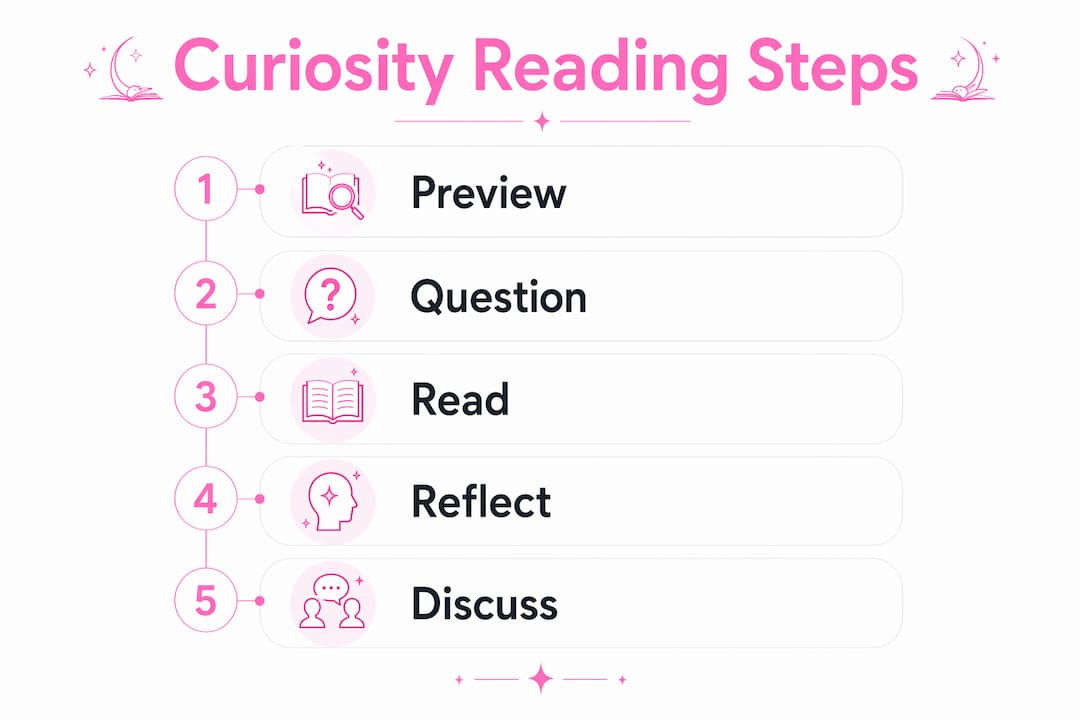
Curiosity-building activities work best when they match where students are developmentally. A debate format that energizes a high schooler will confuse a third grader. Curiosity activities should be tailored to developmental stages to maximize engagement. That means adjusting not just the text level but the type of outcome you expect from students.
For middle schoolers, these approaches tend to land well:
- Prediction stops: Pause reading at a cliffhanger moment and ask students to write or vote on what happens next. Friendly competition around predictions raises the stakes and the energy.
- Text detectives: Students highlight three "clues" in a passage and explain what each clue suggests about a bigger idea.
- Cause-and-effect maps: Students draw visual chains showing how one event in a text triggers another, then debate which cause mattered most.
For high schoolers, the work goes deeper:
- Character motivation debates: Students argue competing interpretations of why a character acted as they did, using textual evidence as their only source.
- Thematic inquiry projects: Students identify a theme, find three texts that address it differently, and write a synthesis that holds the tension between them.
- Spatial puzzles: Students reconstruct the sequence of events in a complex nonfiction text and then argue whether the author's chosen order was the most effective one.
Pro Tip: Match activity complexity to student readiness. Open-ended outcomes work for students who have practiced inquiry before. Students new to curiosity-driven reading need more structure at first, with openness introduced gradually.
Which tools and prompts help cultivate a curiosity-driven reading environment?
The right question at the right moment is the most powerful tool you have. Reading comprehension grows when teachers use "what if" and "I wonder" questions rather than focusing on a single correct answer. That reframe changes the entire classroom culture around texts.
Open-ended prompts that reliably spark student wonder include:
- "What surprised you most in this passage, and why does that surprise you?"
- "If the author left something out, what do you think it was and why?"
- "What question would you ask the subject of this text if you could?"
- "What would change if one key fact in this text turned out to be wrong?"
Teacher modeling is equally important. Thinking aloud with phrases like "I wonder how that works" legitimizes wonder and lowers students' fear of asking questions. When you pause mid-read and say "Huh, I didn't expect that. I'm going to reread this part," you show students that confusion is a signal to lean in, not check out.
Nonfiction texts work especially well as curiosity tools when you frame them as problem-solving resources. Students who read nonfiction picture books as investigative resources generate more student-led questions and move curiosity into action faster than students who read for information alone.
"Reading comprehension is about fostering a thinking process. The goal is not to find the one right answer but to keep asking better questions."
Pro Tip: Build a "curiosity prompt of the day" into your opening routine. Post one open-ended question on the board before students arrive. Give them two minutes to write a response before any instruction begins. This habit trains the brain to enter reading mode with a question already forming.
What are common challenges when trying to spark curiosity in reading?
The biggest obstacle to curiosity-driven reading is the closed-ended worksheet. Closed-ended worksheets suppress curiosity because they signal that reading has one correct destination. Students learn to scan for answers rather than think through ideas. Converting those worksheets into think sheets takes about five minutes of redesign and produces a fundamentally different experience.
Common pitfalls to watch for:
- Answering before students can explore. When you explain the text's meaning before students wrestle with it, you remove the discovery. Hold back. Let confusion sit for a moment.
- Sessions that are too short or too fragmented. A two-minute reading followed by an immediate quiz trains compliance, not curiosity. Students need enough time to get genuinely absorbed.
- Overloading with prompts. Three open-ended questions per reading session is enough. More than that turns inquiry into a checklist.
- Rewarding speed over depth. When students race to finish, they optimize for completion. Reward the quality of questions asked, not the number of answers given.
"Teachers who facilitate rather than dictate the reading process transform texts into tools for solving real problems students actually care about."
When curiosity wanes mid-unit, the fix is usually choice. Let students pick which aspect of the topic they pursue next. Curiosity follows students' natural interests when activities connect observed facts to learning goals. A student who chose their own question is far more likely to keep reading than one assigned a question by the teacher.
Pro Tip: Be transparent about what you do not know. When a student asks a question you cannot answer, say so out loud. Then model how you would find out. That moment teaches more about curiosity than any worksheet ever could.
Key Takeaways
The most effective curiosity-driven reading activities replace closed-ended answer-finding with open-ended inquiry, giving students ownership of the questions that drive their reading.
| Point | Details |
|---|---|
| Think sheets over worksheets | Replace answer-focused worksheets with open-ended think sheets that track evolving student thinking. |
| Match activities to age | Middle schoolers engage through prediction and competition; high schoolers through debate and thematic analysis. |
| Model curiosity explicitly | Thinking aloud with "I wonder" phrases lowers student fear and normalizes questioning as a valued habit. |
| Use nonfiction as a tool | Frame nonfiction texts as problem-solving resources, not information sources, to generate student-led questions. |
| Protect discovery time | Avoid answering too quickly. Let students sit with confusion long enough to develop genuine inquiry. |
Why curiosity in reading is the skill worth teaching most
I have spent years watching educators chase engagement through novelty. New formats, new tech, new themes. What actually moves students is not novelty. It is the feeling that their question matters. The first time I watched a student refuse to put down a nonfiction text because they had to know whether their hypothesis was right, I realized the activity was almost irrelevant. The question was doing all the work.
Modeling curiosity openly shifts classroom culture in ways that no curriculum document can mandate. When you say "I genuinely don't know, and that bothers me in the best way," students see that intellectual discomfort is not a failure state. It is the starting point.
The educators I have seen succeed with curiosity-based reading are not the ones with the cleverest activities. They are the ones who are patient enough to let a question breathe. They resist the urge to resolve tension too quickly. They treat the text as a place students go to find out, not a place teachers go to deliver. That patience is the hardest part to teach, and the most worth practicing.
Adapt slowly. Pick one think sheet. Try one header-to-hypothesis warmup. Watch what happens when students write a question instead of an answer. The shift is quieter than you expect and more lasting than almost anything else you will do this year.
— Noctilucente
Trycurio makes curiosity-driven reading feel natural
Curiosity-driven reading works best when the reading environment itself does not get in the way.
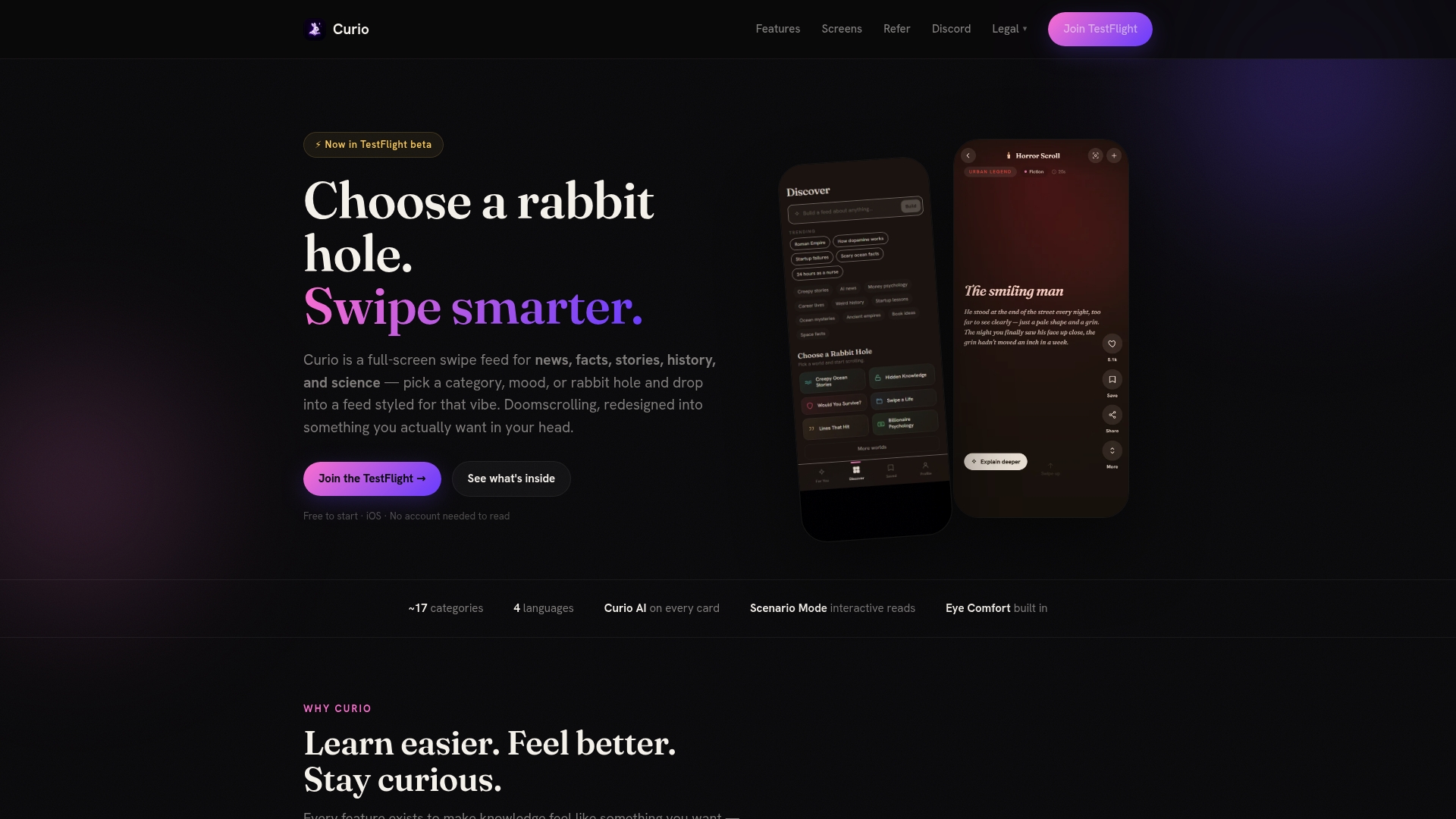
Trycurio is built around exactly that idea. The app segments texts into bite-sized reading activities, each paired with prompts that push students to reflect, question, and go deeper. There are no distracting feeds or algorithmic rabbit holes pulling attention away from the text. Trycurio's AI lets readers summarize, quiz themselves, or dive further into a topic the moment curiosity strikes. For educators who want to move beyond rigid worksheets, Trycurio's reading platform gives students a calm, structured space where genuine exploration feels both supported and safe.
FAQ
What are spark student curiosity reading activities?
Spark student curiosity reading activities are inquiry-driven exercises that replace passive reading with active questioning. They use open-ended prompts, prediction tasks, and exploration cycles to keep students genuinely engaged with a text.
How long should a curiosity-based reading session last?
Focused reading sessions of 5–10 minutes paired with a think sheet prompt are enough to maintain stamina and engagement. Longer unstructured blocks tend to reduce curiosity rather than build it.
What is a think sheet and how does it differ from a worksheet?
A think sheet is an open-ended document where students record questions, connections, and how their thinking changes as they read. Unlike a worksheet, it has no single correct answer and rewards depth of thought over speed of completion.
How do I adapt curiosity reading activities for high schoolers?
High schoolers respond well to character motivation debates, thematic inquiry projects, and tasks that require synthesizing multiple texts. These approaches match their capacity for abstract reasoning and benefit from open-ended outcomes.
Can curiosity be taught, or is it an innate trait?
Curiosity is a habit of mind that can be explicitly taught through inquiry-based curriculum design. Teachers who model wonder aloud and design activities without predetermined outcomes create classrooms where curiosity becomes the norm.