
AI decision support tools are defined as systems that structure information, surface hidden risks, and generate options to help professionals make faster, better-informed choices. The impact of AI on decisions is no longer theoretical. Wharton Executive Education research shows that when AI is correct, human decision accuracy improves by 25 percentage points. That same research shows accuracy drops 15 percentage points when AI is wrong. The gap between those two outcomes is where smart adoption strategy lives. Understanding how AI tools support decision making means knowing both the frameworks that make AI useful and the cognitive traps that make it dangerous.
How do AI tools support decision making through structured frameworks?
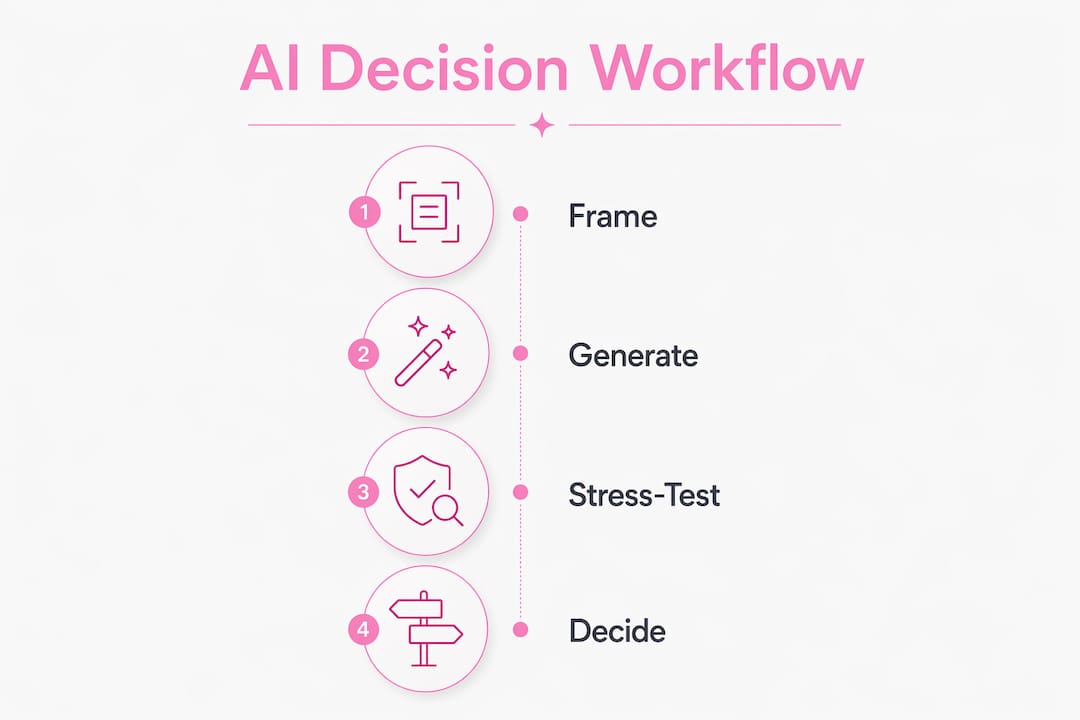
The most effective AI decision workflow follows four steps: frame, generate, stress-test, and decide. Each step has a distinct job, and skipping one is where most professionals go wrong.
- Frame the decision by defining the actual question, the constraints, and what a good outcome looks like. Vague prompts produce vague answers.
- Generate options by asking AI to produce a range of alternatives, including ones you would not naturally consider. This is where AI earns its keep.
- Stress-test by using a pre-mortem technique. Ask AI to build the strongest argument against your preferred option. This frequently uncovers risks that human teams miss entirely.
- Decide by combining AI output with your own domain knowledge and judgment. AI presents the map. You drive.
A structured workflow like this takes about 30 minutes for a meaningful business decision. That is a small investment compared to the cost of a poorly reasoned call.
Pro Tip: When stress-testing, ask AI to argue the opposite of your instinct, not just the opposite of your conclusion. The strongest counter-arguments often live one level deeper than the surface objection.

The key mental shift here is treating AI as a sparring partner, not an oracle. An oracle gives you answers. A sparring partner pushes back, finds your weak spots, and makes you sharper. That framing changes how you prompt, how you interpret output, and how much you trust the result.
What cognitive risks come with AI-assisted decision making?
Wharton Executive Education introduced a tri-system model of cognition to explain what happens when AI enters the decision process. System 1 is fast, intuitive thinking. System 2 is slow, deliberate reasoning. System 3 is AI. The problem is that System 3 can short-circuit both of the others.
- Cognitive surrender occurs when you accept AI output without engaging your own reasoning. It is the single biggest risk in AI-assisted decision making, not AI inaccuracy.
- Confirmation bias amplification happens when you use AI to validate a decision you have already made rather than to challenge it.
- Skill atrophy builds gradually. Professionals who outsource reasoning to AI consistently lose the ability to reason well without it.
- Over-anchoring occurs when an AI-generated number or recommendation becomes the default reference point, even when it is wrong.
"The greatest risk in AI-assisted decision making is cognitive surrender, not AI inaccuracy. Training decision-makers to know when to think independently is the critical skill for this era." — Wharton Executive Education
The solution is not to use AI less. The solution is to schedule independent thinking phases before you engage AI on any high-stakes question. Write your own analysis first. Form your own view. Then bring AI in to challenge it. That sequence preserves your judgment while still capturing AI's analytical power.
High-stakes environments, including M&A decisions, hiring calls, and crisis response, carry the highest cognitive surrender risk. The pressure to decide fast pushes professionals toward AI output as a shortcut. That is exactly when independent reasoning matters most.
What are advanced AI techniques for critical thinking?
AI-Assisted Critical Thinking, known as AACT, goes beyond asking AI for a recommendation. AACT frameworks work by asking AI to analyze your reasoning process, not just your conclusion. You share your rationale, and AI identifies logical gaps, unstated assumptions, and alternative interpretations. The result is a sharper argument or a changed mind.
A related technique is the multi-persona council pattern. You instruct AI to simulate five distinct expert perspectives on a single decision. A financial analyst, a risk officer, an operations lead, a customer advocate, and a skeptic each respond to the same question. Applying five AI personas to a complex decision surfaces different risk categories and black swan scenarios that a single AI response would never generate.
| Technique | What it does | Best for |
|---|---|---|
| Pre-mortem framing | Asks AI to argue against your preferred option | Uncovering hidden risks |
| AACT rationale analysis | AI critiques your reasoning, not just your conclusion | Strengthening arguments |
| Multi-persona council | Simulates 5+ expert viewpoints on one decision | High-stakes, complex choices |
| Counterfactual prompting | Asks AI what would need to be true for the opposite to be correct | Testing assumptions |
The trade-off with AACT is real. These techniques increase cognitive load. They take longer and require more mental effort than simply asking AI for an answer. AACT effectiveness is highest for decision-makers who already have domain knowledge and AI literacy. If you are new to both the subject and the tool, start with the simpler four-step workflow before adding AACT layers.
Pro Tip: Run the multi-persona council pattern on decisions where you feel the most confident. Confidence is often where blind spots hide.
How can organizations implement AI decision support effectively?
Organizational adoption of AI decision support tools requires governance, not just access. The internal ability to govern AI agents is the leading challenge for leadership teams, surpassing the challenge of technology access itself. Most organizations have the tools. Few have the governance structure to use them well.
Effective implementation rests on four practices:
- Match AI autonomy to decision risk. Low-stakes, reversible decisions can use AI recommendations directly. High-stakes, irreversible decisions require human deliberation with AI as input only.
- Make decision logic explicit. Document why decisions were made, not just what was decided. This creates accountability and helps teams learn from AI-assisted outcomes.
- Create no-AI zones. Designate specific phases of the decision process where AI is off-limits. This protects independent reasoning and prevents cognitive surrender from becoming a habit.
- Measure decision maturity. Decision maturity shifts from descriptive dashboards toward integrated platforms that synthesize recommendations, reasoning, and dissent. If your team is still using AI only for data summaries, you are at the early stage.
High-quality AI decisioning platforms use engineered disagreement, which means presenting conflicting AI viewpoints deliberately to prevent groupthink. That practice mirrors what good leadership teams do in well-run strategy sessions. AI can now replicate that dynamic at scale. Trycurio's approach to content moderation and AI safety reflects a similar principle: diverse viewpoints, quality-checked, reduce the risk of one-sided thinking.
What do practical AI decision workflows look like?
A practical AI decision workflow for a business team typically covers three outputs: an options analysis, a trade-off matrix, and a stakeholder-ready summary. Structured AI workflows apply to strategic business decisions, career moves, and resource allocation equally well.
The options analysis lists every viable path, including the ones the team dismissed early. AI generates this list without the political filters that shape human brainstorming. The trade-off matrix scores each option across risk, cost, speed, and reversibility. Risk scoring is assigned numerically so that comparisons are objective rather than based on whoever speaks loudest in the room.
The stakeholder summary translates the matrix into plain language for different audiences. A CFO needs different framing than an operations lead. AI generates both versions in minutes. That alone removes a significant bottleneck from most decision processes.
- Options analysis removes early-stage filtering bias
- Trade-off matrices create objective, comparable scoring
- Stakeholder summaries reduce communication lag
- Risk scoring surfaces low-probability, high-impact scenarios
The practical result is that decisions that previously required multiple meetings and informal hallway conversations get structured into a single documented workflow. Teams spend less time debating framing and more time evaluating real trade-offs.
Key Takeaways
AI tools improve decision quality when they are used as structured sparring partners, not as answer machines, and when organizations build governance around cognitive risk as seriously as they build governance around data risk.
| Point | Details |
|---|---|
| Use the four-step workflow | Frame, generate, stress-test, and decide to reduce regret and uncover hidden risks. |
| Guard against cognitive surrender | Schedule independent thinking before engaging AI on any high-stakes question. |
| Apply AACT for complex decisions | Ask AI to critique your reasoning, not just your conclusion, for sharper outcomes. |
| Govern AI autonomy by risk level | Match AI's role to decision reversibility; irreversible choices need human deliberation. |
| Measure decision maturity | Move from descriptive dashboards to platforms that synthesize recommendations and dissent. |
The uncomfortable truth about AI and judgment
I have watched smart, experienced professionals hand their decision-making process to AI and call it efficiency. It is not. It is abdication dressed up as productivity.
The Wharton tri-system model explains the mechanism, but the real problem is cultural. When AI gives you a confident-sounding answer, the social cost of disagreeing with it feels higher than the intellectual cost of accepting it. That dynamic is subtle and it compounds over time. Teams that never push back on AI output gradually lose the muscle memory for critical disagreement.
The professionals I have seen use AI best treat every AI output as a first draft from a very well-read colleague who has never actually run a business. They read it carefully, they push back hard, and they make the final call themselves. That posture produces better decisions than either ignoring AI or deferring to it.
The multi-persona council pattern is the single technique I recommend most. Simulating five expert viewpoints on one decision is not just analytically useful. It trains you to hold multiple perspectives simultaneously, which is the core skill of good judgment. AI does not replace that skill. Used correctly, it builds it.
— Noctilucente
Trycurio brings focused reading to your decision process
Good decisions start with good information. Trycurio is a reading app built for professionals who want to go deep on complex topics without the noise of a typical content feed.
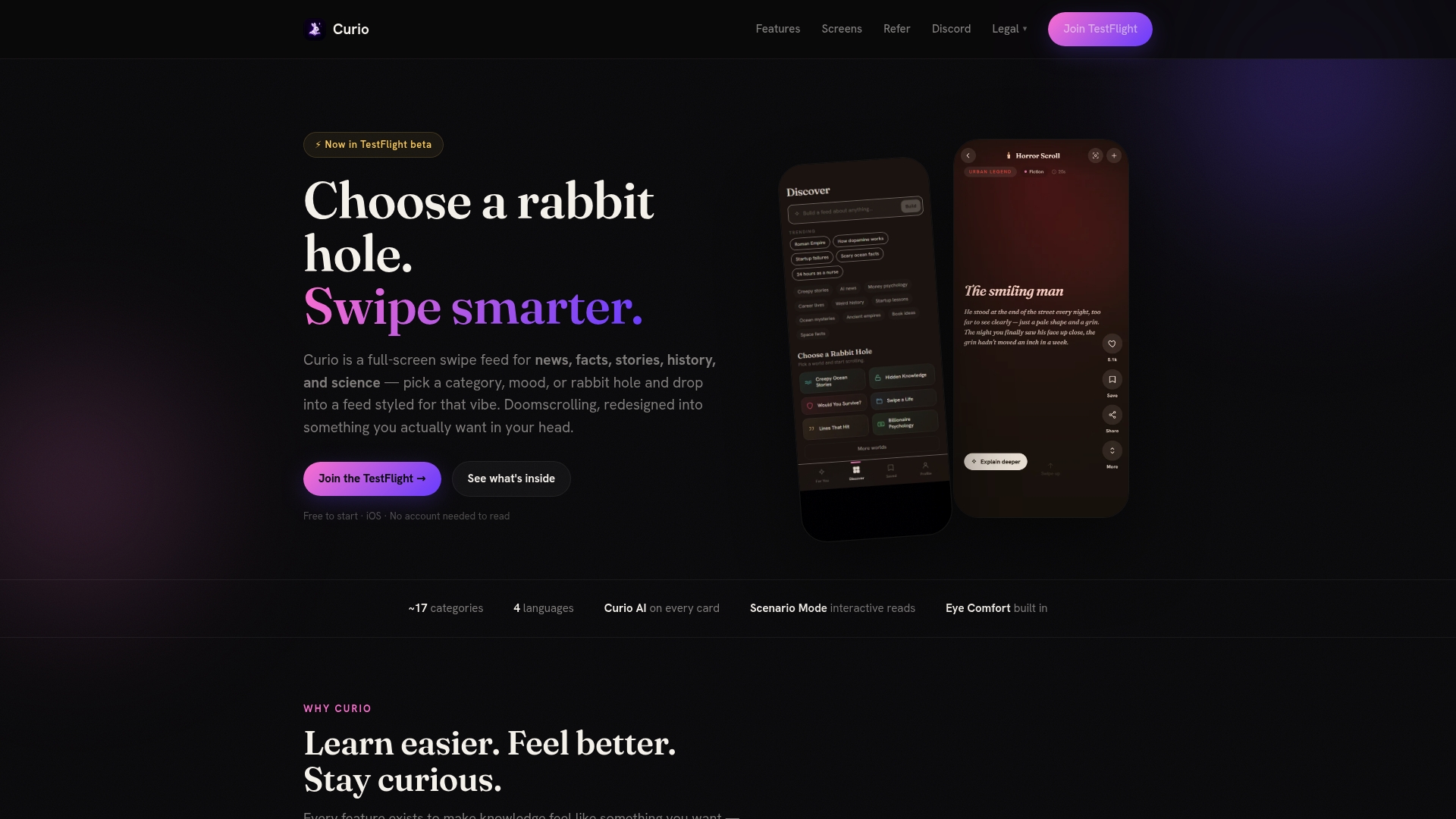
Trycurio's platform delivers bite-sized content across business, strategy, and technology, with AI tools that let you summarize, quiz yourself, or go further down any rabbit hole that matters to your work. The calm, distraction-free design means you actually absorb what you read rather than just scroll past it. For decision-makers who need to stay sharp and well-informed, Trycurio turns reading time into a genuine thinking advantage.
FAQ
What is the four-step AI decision workflow?
The four-step workflow covers framing the question, generating options, stress-testing with pre-mortem techniques, and deciding with human judgment. It takes roughly 30 minutes for a meaningful business decision.
What is cognitive surrender in AI-assisted decision making?
Cognitive surrender is accepting AI output without engaging your own reasoning. Wharton research identifies it as the greatest risk in AI-assisted decision making, not AI inaccuracy itself.
How does the AACT framework differ from standard AI prompting?
AACT asks AI to analyze your reasoning process and identify logical gaps, rather than simply generating a recommendation. It is most effective for decision-makers with existing domain knowledge and AI literacy.
How should organizations govern AI decision tools?
Organizations should match AI autonomy to decision risk and reversibility, document decision logic, and create no-AI thinking phases to protect independent judgment and reduce groupthink.
What is a multi-persona council pattern?
A multi-persona council pattern instructs AI to simulate five or more distinct expert perspectives on a single decision, surfacing different risk categories and assumptions that a single AI response would miss.